Love sure plays a big role in the Christian story, or so I’ve discovered as I’ve gone on the quest to evaluate the Christian story through McKee‘s 8 Stages of Story. Because of this, I believe the Christian story must at some level be considered to be of the Love Story genre.
Shawn Coyne and his crew are experts on story genre. To teach us more about genre, they have tackled a project of evaluating what he believes to be the best in each of many genre categories. And for the Love Genre, he picked this book to evaluate. Check out what he says about the love genre…
So, sure the short-term primal genres (Action, Horror, War, Thriller) concern the concrete foundation of Maslow’s Hierarchy of Needs…how to survive today.
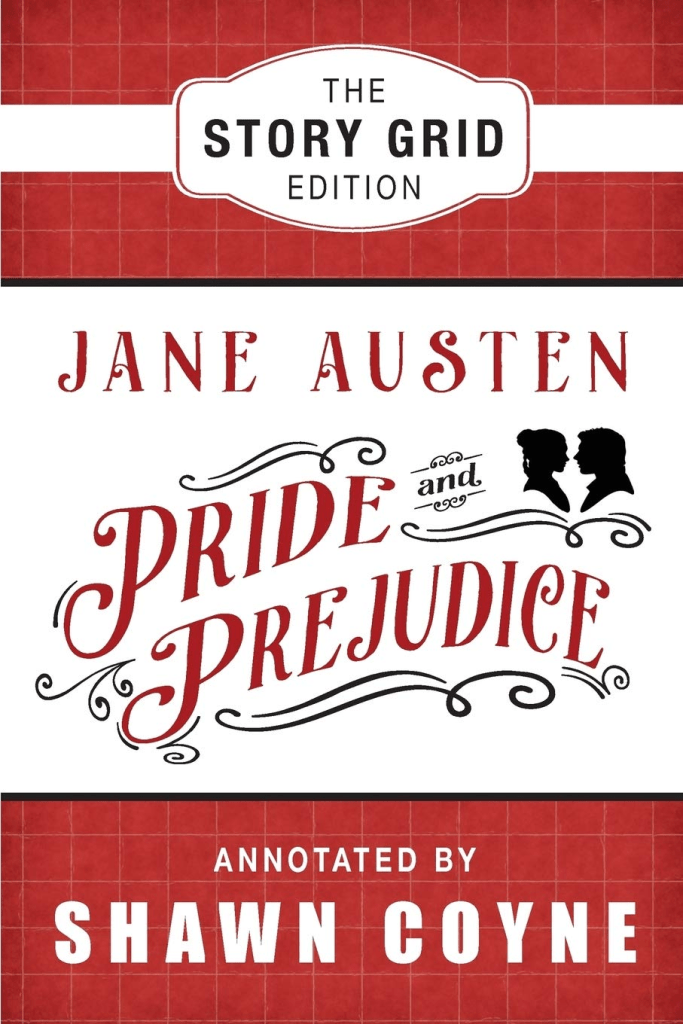
Pride and Prejudice: The Story Grid Edition, by Jane Austen (Author), Shawn Coyne (Introduction)
But the Love Story is the long-term mother of all Genres.
It’s not just about how to survive today; it’s about how to last a lifetime…and even how to gain a measure of immortality by co-creating offspring.
Is Jesus the active hero in an archplot love story?
If he is, it weaves together with the love genre…
Love is the force that not only binds us to the rest of humanity…it’s the very thing that preserves our species. To fail to love, therefore, is not only an external threat to our own private lives; a love breakdown across humanity will take down our entire life-form.
Pride and Prejudice: The Story Grid Edition, by Jane Austen (Author), Shawn Coyne (Introduction)
This famous passage, which I believe to be the Controlling Idea of the Christian story, fits with the love genre…
For God so loved the world, that he gave his only Son, that whoever believes in him should not perish but have eternal life.
Let’s look what Jesus declared about the greatest love there is…
Greater love has no one than this, that someone lay down his life for his friends.
Jesus sure fits with Coyne’s description of the hero in a story…
[A] lead character that is heroic in nature meaning that they end up sacrificing themselves for the greater good of humanity.
That’s what a hero does.
Shawn Coyne, in Hero’s Journey – Moments
And here’s Steven Pressfield…
The sacrifice of one’s own life (or happiness or future prospects or whatever) for the good of others is the defining act of the hero.
Give Your Hero a Hero Speech, By STEVEN PRESSFIELD, Steven Pressfield Online, JANUARY 17, 2018
And McKee sums it up most concisely of all…
Can we really say that horror has no heroes? That depends, to some extent, on what you mean by “hero.” So, at a break in the session, I approach McKee and ask him to define the term. It’s a question that has been pondered by scholars and writers throughout the ages, but McKee dismisses it with a swing of his hand. “A hero,” he says in the voice of God, “is willing to sacrifice his life for another.”
ROBERT MCKEE’S UNCONVINCING STORY, BY JASON ZINOMAN, Vanity Fair, DECEMBER 2009
And Coyne again…
That is the heroic tradition, where the hero sacrifices themselves for the good of the larger good.
Shawn Coyne, Nailing the End of Your Book
So, that sounds a lot like…
Jesus said to him, “Today salvation has come to this house, because this man, too, is a son of Abraham. For the Son of Man came to seek and to save what was lost.”
Here’s more straight from the horse’s mouth…
For even the Son of Man did not come to be served, but to serve, and to give his life as a ransom for many.
I am the good shepherd. The good shepherd lays down his life for the sheep. He who is a hired hand and not a shepherd, who does not own the sheep, sees the wolf coming and leaves the sheep and flees, and the wolf snatches them and scatters them. He flees because he is a hired hand and cares nothing for the sheep. I am the good shepherd. I know my own and my own know me, just as the Father knows me and I know the Father; and I lay down my life for the sheep.
At a certain point in each of the four gospels, Jesus made it clear he was going to lay down his life…
From that time on Jesus began to explain to his disciples that he must go to Jerusalem and suffer many things at the hands of the elders, the chief priests and the teachers of the law, and that he must be killed and on the third day be raised to life.
There it is. It’s the Christian story…
By this we know love, that he laid down his life for us, and we ought to lay down our lives for the brothers. But if anyone has the world’s goods and sees his brother in need, yet closes his heart against him, how does God’s love abide in him? Little children, let us not love in word or talk but in deed and in truth.
And look at this, describing what a convert is entrusting himself to…
When a gentile convert stood in the baptistery on Easter’s eve and, before descending naked into the waters, turned to the West to renounce the devil and the devil’s ministers, he was rejecting, and in fact reviling, the gods in bondage to whom he had languished all his life; and when he turned to the East to confess Christ, he was entrusting himself to the invincible hero who had plundered hell of its captives, overthrown death, subdued the powers of the air, and been raised the Lord of history.
Christ and Nothing, David B. Hart, First Things, October 2003
And look at this big picture description…
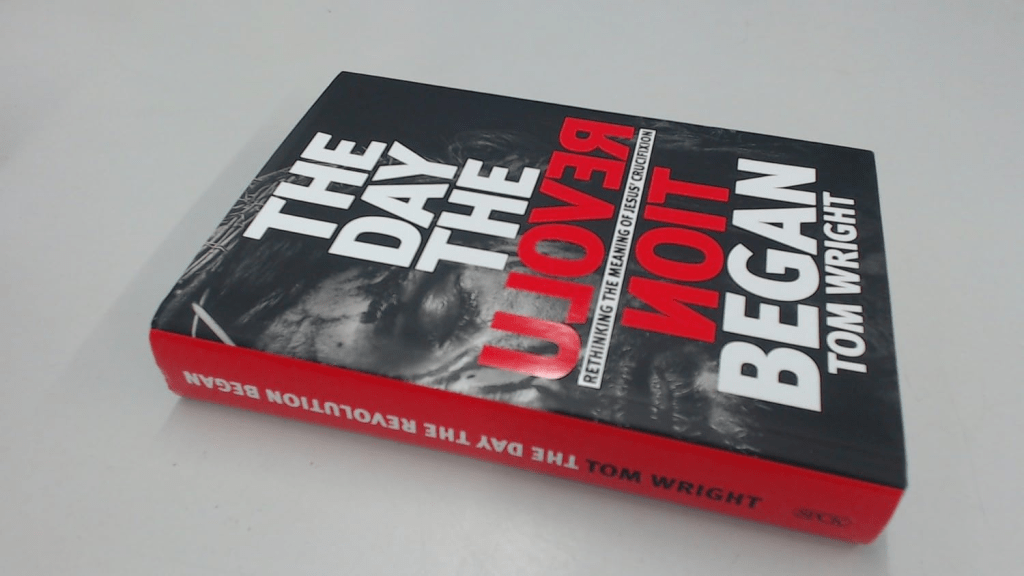
“YOUNG HERO WINS HEARTS.” Had there been newspapers in Jerusalem in the year we now call AD 33, this was the headline you would not have seen. When Jesus of Nazareth died the horrible death of crucifixion at the hands of the Roman army, nobody thought him a hero. Nobody was saying, as they hurriedly laid his body in a tomb, that his death had been a splendid victory, a heroic martyrdom. His movement, which had in any case been something of a ragtag group of followers, was over. Nothing had changed. Another young leader had been brutally liquidated. This was the sort of thing that Rome did best. Caesar was on his throne. Death, as usual, had the last word.
Except that in this case it didn’t. As Jesus’s followers looked back on that day in the light of what happened soon afterward, they came up with the shocking, scandalous, nonsensical claim that his death had launched a revolution. That something had happened that afternoon that had changed the world. That by six o’clock on that dark Friday evening the world was a different place.
Nonsensical or not, they were proven right. Whether we believe in Jesus, whether we approve of his teaching, let alone whether we like the look of the movement that still claims to follow him, we are bound to see his crucifixion as one of the pivotal moments in human history. Like the assassination of Julius Caesar around seventy years earlier, it marks the end of one era and the start of another.
And Jesus’s first followers saw it as something more. They saw it as the vital moment not just in human history, but in the entire story of God and the world. Indeed, they believed it had opened a new and shocking window onto the meaning of the word “God” itself. They believed that with this event the one true God had suddenly and dramatically put into operation his plan for the rescue of the world.
N.T. Wright, The Day the Revolution Began: Reconsidering the Meaning of Jesus’s Crucifixion
And here’s another consideration from Shawn Coyne…
The structure is archplot, which is what Joseph Campbell calls the hero’s journey.
Genre Review, by Shawn Coyne
Let’s look at how it fits with the story of Jesus as a hero, as described by a famous Christian preacher…
But perhaps the single most consoling and appealing theme is what theologian Roger Nicole has called the one, irreducible theme that runs through every single one of these models…. Nicole taught that, regardless of the grammar being used, the essence of the atonement is always Jesus acting as our substitute. Jesus fights the powers, pays the price, bears the exile, makes the sacrifice, and bears the punishment for us, in our place, on our behalf. In every grammar, Jesus does for us what we cannot do for ourselves. He accomplishes salvation; we do nothing at all. And therefore the substitutionary sacrifice of Jesus is at the heart of everything.
This act- giving one’s life to save another– is the most compelling, attractive, and electrifying story line there is. J. K. Rowling, for example, could hardly end her Harry Potter series in any other way because it is the ultimate drama, the most moving ending possible. Lifting up the substitutionary sacrifice of Christ is the ultimate way to appeal to any culture, to attract them to him. The various ways of speaking about the atonement furnish us with wonderfully fitting ways of showing each culture how this atoning work of Jesus specifically solves its greatest problems and fulfills its greatest aspirations.
We live in the first era of history that considers happy endings to be works of inferior art. Modern critics insist that life is not like that – rather, it is full of brokenness, paradox, irony, and frustration. Steven Spielberg was denied Oscars until he stopped making movies with happy endings and directed Schindler’s List. Yet people continue to flock to movies and read books that have fairytale endings. There are deep human longings that modern realistic fiction can never satisfy: to escape death and live forever; to hold communion with other personal beings like elves or aliens or angels; to find love that perfectly heals and from which we never part. Most of all, we want to see and, if possible, participate in the final triumph over evil in the world. People turn to fairy tales because they depict these desires coming true.The gospel is by no means a sentimental view of life. In fact, the Bible has a far darker vision of reality than any secular critic. It tells us that Satan and his legions of demons are at work in the world. It tells us we are so deeply flawed and cruel we can’t save ourselves without God’s intervention. And yet the gospel has an astonishing message about these longings for love and death and triumph. First, the gospel explains them. Human beings have been made in the image of God, which means we were originally designed to know and experience all of these things. We were created to live forever. Second, the gospel tells us that the resurrection of Jesus Christ is hard proof that all of these things will come true again. If you believe in Jesus Christ, you will see and know escape from death, love without parting, and triumph over evil. You will talk to angels and supernatural beings. You will live forever. And why will we get eternal life? Because he was killed. We get eternal love because he was forsaken. We triumph over evil because he was tortured, murdered, and defeated. In the salvation of Jesus Christ, we learn that the happy ending we long for is not a fairy tale.
The gospel is the deepest consolation you can offer to the human heart. Once you have taken care to enter and have found the courage to challenge the world of your hearers, be sure to offer this consolation with the passion of one who has experienced it firsthand.
Timothy Keller, Loving the City
Here’s more on Jesus the hero and his loyal love for humans…

The staggering part is that God doesn’t just permit us to know Him, He sacrificed deeply to make it happen! God doesn’t simply leave an invitation on the table – He paid the highest possible price to make it a reality.
You and Me Forever, By Francis Chan and Lisa Chan
There is no greater love story. The Judge of the universe chased after those who rebelled against Him. People made themselves God’s enemies by rejecting His rule and following their own desires. Yet God so loves His “enemies” that He sent His Son to pay the penalty for their crimes. God’s wrath was satisfied as Jesus hung on the cross. Through His death, believers are cleared of their sin and reconciled to the God they once rejected. This makes God both fair and forgiving, just and justifier (see Rom. 3:21-26). He is just because His judgment against our sin was carried out. We are justified because His innocent Son suffered on our behalf.
Jesus is the best example of a hero…
Just as we might instruct a young person in a given sport by showing examples of the greatest practitioners of that game, so we show the nature of Christianity best, perhaps, in its heroes.
EVANGELIZING THE NONES: THE 2017 ERASMUS LECTURE, by Robert Barron, First Things, January 2018
The hero’s journey stories are inspiring…
As the author of biographies of great men and women I have seen firsthand just how deeply encouraging and inspiring the stories of heroes can be. There seems to be something within the human breast that naturally responds to such stories, that positively longs for them. For some reason having to do with our nature, heroic examples call forth from us a powerful desire to be good and great and heroic ourselves.
Eric Metaxas, If You Can Keep It
Here’s something from Shawn Coyne’s team…
So when you say, “I felt good about this story because it’s true,” that you’re absolutely right, and the reason why it’s true is that it mirrors the hero’s journey. The hero’s journey is really deep, deep stuff.
Truth vs. Truth, By Tim Grahl, Story Grid Podcast
So, it looks like the Christian God is on a Quest, and that quest is the hero’s journey.

